

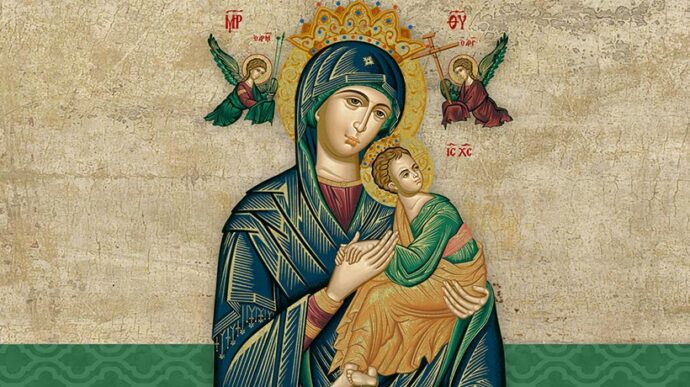
The Greatness of Our Virgin Mary
“Indeed, blessed are those who hear the word of God and keep it.” (Luke 11:28)
This is the Lord’s response to the exclamation of a simple woman, overwhelmed by the awe she experienced in His presence and through His teaching: “Blessed and happy is the woman who gave birth to You and nursed You.” Truly, what greater praise can there be for a person who is regarded as a blessing to his fellow human beings than to refer to his mother? If we ourselves often feel the same way—if we bless the mother of a person because he exists in this world as a true adornment, because his presence ennobles perhaps the whole human race, either through the gifts he offers for the benefit of society or through the purity of his soul, which enables him to function as a fragrance that is, literally, heavenly—how much more did this apply when God Himself came into the world as man?
Christ “went about doing good and healing all.” He continually did good and healed everyone, according to the word of Scripture. Therefore, the woman’s exclamation of praise concerning His Mother—“Blessed is the Mother who gave birth to You”—must be regarded as the most logical, but also the most grace-filled, tribute ever given to Him: because of Him, they blessed the One who brought Him into the world as a human being!
And how did the Lord, God incarnate, respond? What did He say? He did not dismiss the praise, nor did He silence it, ignore it, or react negatively, as He usually did when words of praise were directed immediately toward Him. He would reject such praise, forbid it, and withdraw. But the words concerning His Mother He confirmed—and indeed in the strongest possible way.
“Not only is what you say true, but even more so!” “Indeed!” Certainly. Absolutely.
According to the rendering of the great and wise late hierarch, Metropolitan Dionysios (Psarianos) of Kozani: “Joy, and thrice joy to Her!” For, as is readily understood, such a Daughter—with such purity of soul, such humility and love, and such readiness to obey the will of God—had never existed in the world, nor would there ever be another like Her.
“When the fullness of time had come,” the Apostle Paul writes by divine inspiration, “God sent forth His Son, born of a woman.” This woman, the Panagia, the Virgin of Nazareth, was awaited by all the ages. In Her alone the prophecies of the Old Testament were fulfilled, and especially the Protoevangelium given after the fall of our first ancestors: “the offspring of the woman shall crush the serpent—the devil.” And indeed, this was fulfilled: at the Annunciation of the Theotokos, the Protoevangelium was fulfilled.
The Lord’s words that follow confirm this reality in the best possible way: “Blessed are those who hear the word of God and keep it in their lives.”
His Mother, then, is not blessed simply because She was chosen to become the bridge through which God would come into the world. She is blessed because, from Her earliest childhood, She was already oriented toward the word of God, toward His love, and toward obedience to His holy will, as we have mentioned above.
Mary, who at the age of only three was brought into the Holy of Holies of the Temple, lived like an angel of Heaven, giving absolute priority in Her life to God Himself. The commandment, “You shall love the Lord your God with all your soul, with all your heart, and with all your strength,” was the guiding principle that held Her entire being together.
How, then, could She not become the Mother of God incarnate, when He found in Her the dwelling place He was seeking? “I will dwell in them and walk among them, and they shall be My people, and I shall be their God,” was His promise. And the young Mary became the “ground” upon which this promise was fulfilled. Communion with God, one might say, was destined to take place.
And this orientation and love toward God was not something temporary. From the beginning to the end of Her life, the Theotokos was a continual “yes” to Her Son and God. This means that His blessing upon His Panagia Mother was continually increasing: Her heart was like the burning bush that burned without being consumed by the grace of God.
And together with Him, Her blessedness would continue to be proclaimed by the hearts and lips of every faithful member of His Body, from that time until the end of the ages and beyond.
She Herself prophetically proclaimed this: “Behold, from now on all generations will call me blessed.”
There is no Christian who truly bears this name and whose attitude toward the Panagia can be different from that of God Himself.
The Lord’s emphatic confirmation of the simple woman’s blessing of the Panagia, His Mother, also serves as a guiding light for every believer. We know that listening to and studying the word of God, when it leads to its application and embodiment in our lives, brings the abundant grace of God. God praises us and finds rest in our hearts and throughout our entire being.
And it could not be otherwise, since the Lord Himself confirmed that within His word and His commandments is ultimately contained His almighty divine energy.
Our Church insists, at every feast of the Theotokos—and especially at the greatest of them all, Her Dormition—to remind us of this truth. For the Church is concerned not merely that we glorify the Panagia, but that we too may become little “Panagias”—a reality that constitutes the greatest glorification we can offer to Her.
